Motivation
At Electricity Maps, we care deeply about our API users. We're proud of our years of 100% uptime (except for that one CloudFlare outage...) and we want to keep delivering new features and signals at a rapid pase.
We had the basics in place (unit tests, types, e2e tests), but I wanted to take it one step further and do something that would give engineers an extremely high confidence about their changes before pushing that green button to merge and deploy.
Solution
The best mock data is real data - and the best mock server is our production server. So I built a tool that:
- calls all requests in a Postman collection using production environment
- Save the responses
- Repeat for local environment (connected to prod DB or replica)
- Diff the responses
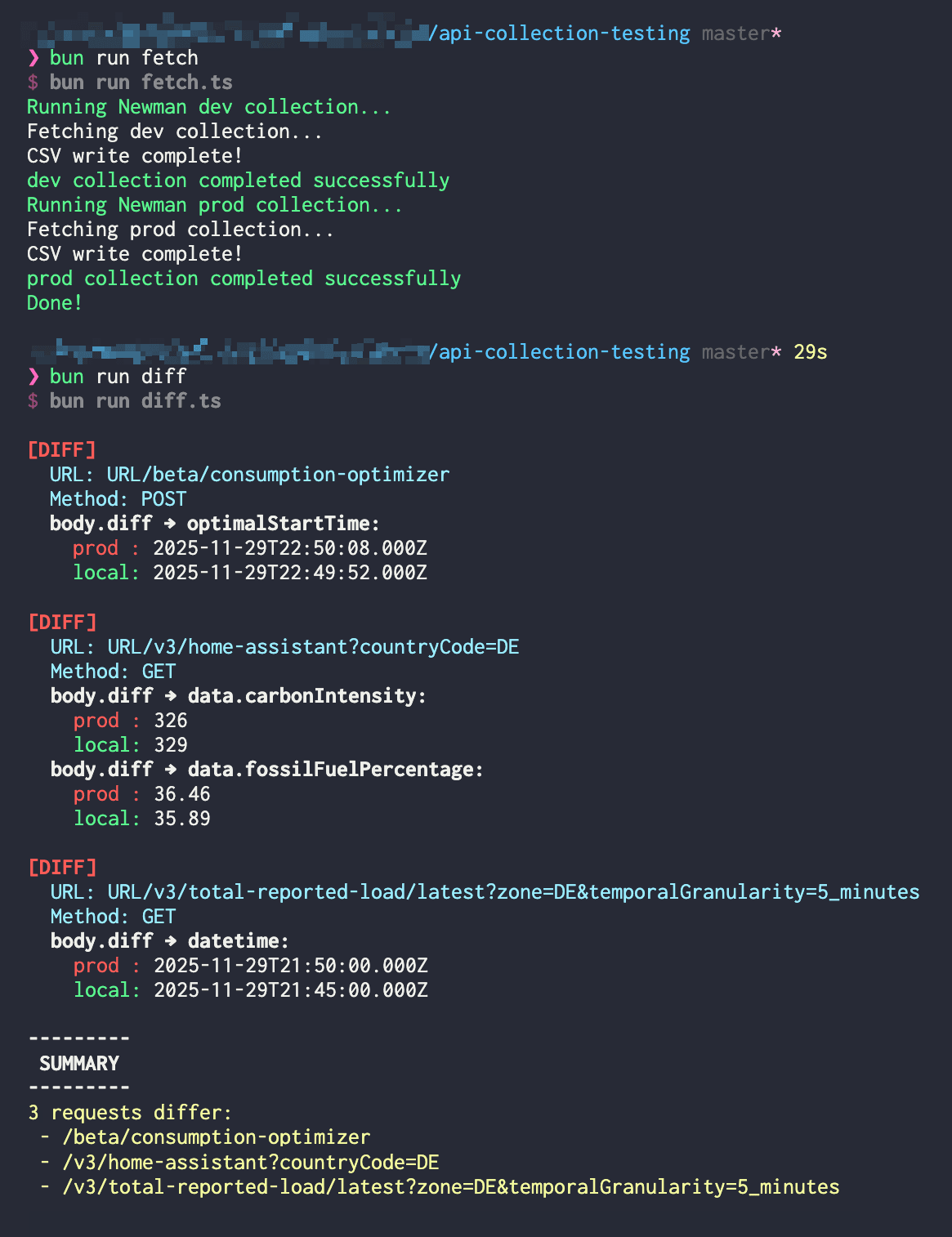 Fetching and comparing the API responses
In short this is a glorified characterization test (also known as Golden Master Testing), but with real data instead of snapshots that can drift. This is powered by a Postman collection for automating the calls, so as a bonus it helps us ensure we have proper coverage of our API in Postman for all engineers to enjoy.
The tool also runs any Postman tests on your collection, so for our 101 requests it also executes 339 basic tests that checks response codes and response structures look as expected for an extra layer of testing.
Caveats
-
It requires that you can read data from the same place as in production - we use Google Cloud SQL Auth Proxy to connect locally to a replica of the production database.
-
This works great for all requests that don't modify anything on the server (you probably don't want to spam
DELETE /users), so consider having a separate Postman collection if that is a problem. -
Make sure you have separate requests for testing various combinations parameters and edge cases.
-
We run this tool manually before merging larger changes - it could be automated, but given the broad range of other automated tests we have this serves as a last verification.
-
We could optimise towards fewer calls to the API by using saved responses in Postman as snapshots, but those can and will drift - so we'll rather send a bit of extra traffic at prod.
Implementation
In short it works like this:
Fetching responses
- Use Newman (Postman's CLI/SDK) to run over collection
- Use newman-reporter-csv to store
responses as CSVs
- The JSON reporter returns data as streams, making it hard to diff and it creates massive files
- The CSV reporter makes it possible to get response body as plain text, which then allows us to convert that into JSON for a richer diffing and comparison of key-level values later
- Ensure the Postman collection uses variables for URL, so you can replace that in the script
Comparing responses
- Use PapaParse for handling CSVs
- Ignore responseTime and responseSize columns
- Allow ignoring specific keys that differ (such as timestamps and headers)
- Diff the response body first, and only if there are any changes go deeper and report on the exact JSON key value differences
The code is not yet open source, but I'm happy to share more details if anyone is interested :)